
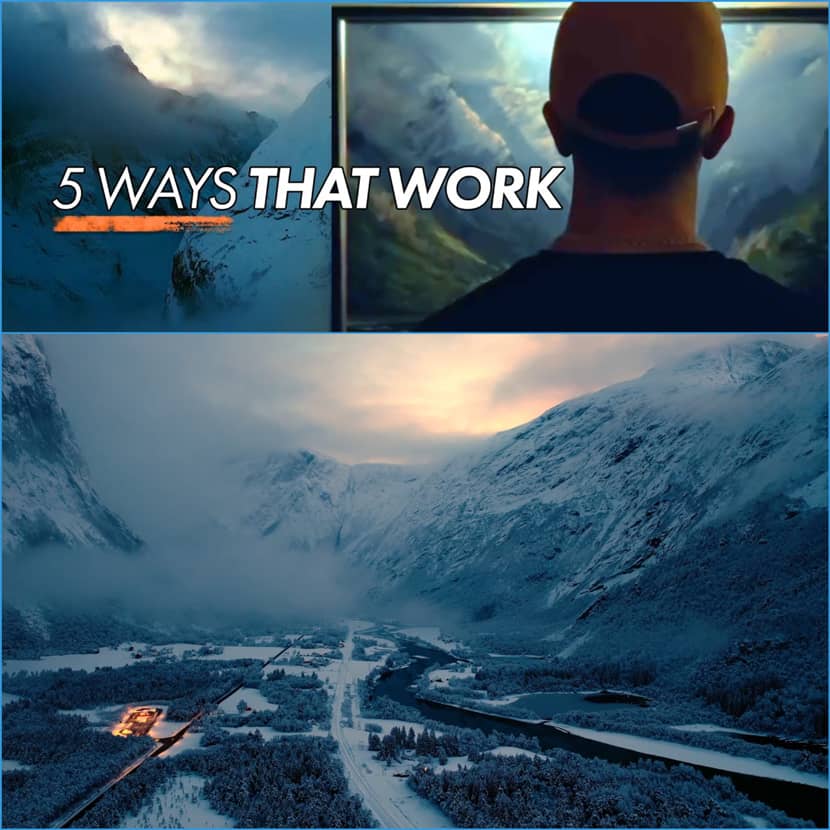
Everyone experiences creative blocks. In this insightful video, Walid Feghali outlines five useful strategies that he used to restart his creativity after losing enthusiasm due to life's obstacles and technological issues. He offers straightforward, useful advice that may be used to any creative field, including digital art, music, architecture, and design!
When Creativity Comes To A Standstill.
Every creative person ultimately encounters times when things abruptly stop moving forward. When Walid Feghali's computer crashed while he was working at his remote creative farm in Norway, this moment came as a surprise. Many of his endeavors were abruptly halted because he lacked access to the instruments he needed for painting, writing, or creating digital work.
During those weeks, something familiar to many creators began to happen. Motivation slowly disappeared. Without the ability to work normally, the creative momentum faded, and inspiration felt distant.
But as Walid explains, most individuals are unaware of how frequent this issue is. The creative cycle naturally includes periods of stasis. The crucial thing is not whether they occur, but rather how we react to them.
In his video, Walid shares five practical strategies that helped him regain his creative flow.
1. Reconnect With Inspiration.
The first step is quite easy: re-establish a connection with your original inspiration instead of attempting to force creativity.
Walid says that instead of creating something right away when he's feeling artistically stalled, he spends time reading inspiring content about his craft. For instance, he revisits some of his earlier paintings or investigates motivational concept art when he feels like painting again. He listens to works that inspire him to write music. The goal is not productivity but curiosity.
He reminds himself of the reasons he initially fell in love with these artistic endeavors by revisiting sources of inspiration, such as astrophotography photos of nebulae, galaxies, or deep space. The creative motor is progressively restarted by inspiration.|
This method allows creativity to resurface organically by changing the mindset from one of pressure to one of curiosity!
2. Start Extremely Small.
A powerful solution to creative paralysis is lowering expectations dramatically and instead of attempting a large project immediately, start with tiny creative actions.|
For example, you can sketch a few small thumbnails instead of a full painting, play a few chords instead of composing a complete musical piece, or spend a few minutes experimenting in Blender instead of building an entire scene.
These small steps reconnect you with your craft without the pressure of producing something totally perfect. Small actions reduce the psychological barrier to starting, and the moment something small is accomplished, motivation begins to grow again. Is that simple!
3. Use Newton’s Law Of Motion To Your Advantage.
One of the most interesting ideas in the video is the comparison between creativity and Newton’s First Law of Motion. Newton’s law says that an object at rest stays at rest, and an object in motion stays in motion unless acted upon by some external forces. This principle is known as inertia and it explains why it can feel so difficult to start creating after a long period of pause.
When creative work stops for a while, we are essentially like a parked car which need significant effort to push it again into motion. However, once the car begins moving, its move becomes easier.
The same applies to creativity. A quick sketch, a short experiment, or a few minutes of work act as the initial force that breaks the inertia. Once momentum builds, motivation becomes less important because the process itself carries you forward.
4. Enter The Curiosity Loop.
Another concept that Walid usually uses is what he calls the Curiosity Loop. This simple learning cycle consists of four steps:
- Become curious about something
- Research the basics
- Try it yourself
- Adjust and try again
Small progress bursts and instant feedback are produced with each iteration of this loop. These tiny gains provide the brain a sense of accomplishment and motivate it to keep investigating.
Repeating this cycle over time eventually eliminates resistance and frequently puts producers in the highly creative flow state, a state of mind where invention seems effortless and intensely concentrated.
Walid summarizes this philosophy with a simple phrase: “Practice makes progress.”
5. Give Yourself Permission to Rest.
Knowing when not to produce is maybe the most overlooked piece of advise for creative professionals.
Walid highlights that taking pauses from productivity is totally appropriate. Regaining creative energy might be facilitated by relaxing, playing games, watching movies, or spending time outside.
People who are creative frequently experience pressure to create new work all the time, yet this kind of thinking can backfire.
Sometimes mental exhaustion rather than a lack of inventiveness is the true problem. Resting can naturally renew motivation and curiosity, allowing creativity to resurface on its own.
Creative Low Phases Are Temporary.
One of Walid's video's most comforting lessons is that creative stall does not always indicate a lasting problem. It doesn't imply you've lost your talent or passion if you haven't completed a project or worked on your trade in a long time.
It just indicates that you are experiencing a low point, which will soon pass like any other phase.
Creators can progressively recover the joy of creating things by reestablishing a connection with inspiration, starting small, building momentum, investigating curiosity loops, and making time for relaxation.
🎥 Watch the full video below:
About Walid Feghali.
Walid Feghali is a composer, artist, commercial pilot, and mechanical engineer based in Sweden. Through his YouTube channel and his online education platform Evenant, he shares insights about creativity, music composition, and artistic growth. His content combines artistic philosophy with practical learning techniques, helping creators develop their skills while maintaining curiosity and passion for their craft.